Contraception (Part 1)

“And God created man to his own image: to the image of God He created him: male and female He created them.” (Gen 1:27) Since God is Trinity, therefore infinitely fruitful, eternally begetting His Only Begotten Son, He gave man of His own power to transmit life: “Increase and multiply”! We must never forget that God doesn’t need human parents to bring children in the world – He made Adam and Eve directly, and He creates every human soul of every human being that is conceived. He could also have created every human body. And by the way, Angels don’t reproduce, God made them all directly.  There are no family among the angels…

Having said this, one can see the great dignity of being parents, pro-creators, which means working with the Creator, to bring children in the world, for the purpose of filling the places left empty in Heaven by the fall of the bad angels. “To people Heaven with elects”, that is the ultimate and fantastic goal of marriage.

Any surprise, then, that the devils, out of sheer jealousy, will do all they can to prevent humans from taking their places in Heaven? They do that not just by making people fall into mortal sin, live and die in mortal sin, but also by trying from every angle possible to stop humans from reproducing. One of the best means so far has been through contraception, especially “the pill”, since the 1960s in particular.

When Paul VI published in 1968 his encyclical Humanae Vitae which condemned contraception, he took everyone by surprise, as the worldwide trend was really in favor of it.

And sad to say, although many Episcopal Conferences then published statements regarding Humanae Vitae, it is the Canadian Bishops' statement –The Winnipeg Statement, of Sept 27, 1968 - which has been the subject of the most controversy, as it has been widely interpreted as a loophole whereby Catholics may feel permitted to use birth control. Central to the debate is the role and importance of personal religious freedom of conscience.

Paragraph 26 stated: "In accord with the accepted principles of moral theology, if these persons have tried sincerely but without success to pursue a line of conduct in keeping with the given directives, they may be safely assured that, whoever honestly chooses that course which seems right to him does so in good conscience." Which simply means, “if you think contraception is fine, then use it” no matter what the Church teaches.. As Saint Pius X taught in his encyclical on modernism, even the supreme authority in the Church must bow to the individual conscience.

Recently this teaching of Humanae Vitae condemning contraception is back in the news, not only because it is the 50th anniversary of the document, but more so, and sadly so, because many in the Church are trying to reverse this official teaching as they are trying to reverse other teaching concerning various aspects of marriage, such as divorce.

But you will not read in the news that the very first cause of divorce is precisely contraception which goes directly against the very first goal of marriage and which kills love at its source.  (To be continued)
Only a Grain of Incense

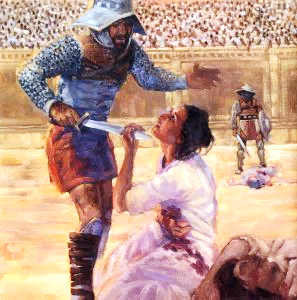
Throughout the year we celebrate innumerable feasts of martyrs of every condition and age. Many of them suffered in the ten great Roman persecutions up to the Fourth Century, and in a number of cases, the Christians who had been arrested were simply asked to offer a bit of incense, sometimes a simple grain, to a pagan idol. “Be reasonable! Offer a little of this incense and you can go home to your husband, your wife, your children! If you don’t offer it, you will never see them again, we will put you to death!”  And like the old man Eleazar (cf. 2 Mac 6), they would prefer to lose this perishable life and win the crown of Heaven rather than the opposite. They had great faith and they were willing to die for it. They were indeed living the Mass.

We recall these facts of history to help us live our faith today. And right now, right here in Canada, that infamous ‘grain of incense’ has become as insignificant as ‘ticking a box’ on a form, and the idol of the day is the liberal agenda of abortion, homosexuality, gender theory and all the anti-life issues.

During the month of January, it was reported in the news that the Federal Government of Canada made changes to their youth summer jobs program, which provides grant money to various employers to hire students.  When they complete the online application form, applicants must agree with the “reproductive rights, along with other human rights", which means explicitly “abortion and gender rights.” Now, unless the electronic form is checked, the applicant organization will not receive funding. Basically, the government is asking non-profit organizations begging for Caesar’s manna to offer a pinch of incense to the modern-day pagan gods, symbolized by the “human rights.” This is really a modern-day version of persecution from the state, and we should never compromise our faith for the sake of grants to be received from the government.  

St Paul was inspired and really prepared Christians of all centuries when he wrote back in 67 A.D. “Persecutions, afflictions: such as came upon me at Antioch, at Iconium, and at Lystra: what persecutions I endured, and out of them all the Lord delivered me. And all that will live godly in Christ Jesus, shall suffer persecution.” (2 Tim 3:12)

 We may think that the persecution of Christians is something foreign to us, and rather limited to some remote Islamic or Communist countries, while we are safe here in our Western countries, in our warm homes.  This pious wish may not be true for long in Canada.

Let this upcoming Lenten season prepare us for the hard times that may be at the door. Let us also make an effort to know better and live fervently the Holy Sacrifice of the Mass by generous acts of self-denial and some extra sacrifices

Sacrifice.png

The Symbolism of the Offertory - Part 4

Second Part: The Symbolism of the Offertory

Let us now look at the ceremonies, some ceremonies of the Offertory more precisely.  It is not possible to say much in a few short minutes, as it is so rich. Moreover, the various conferences of this Congress will deal with many facets of this divine diamond.  Rather than skim over too many aspects, I would like to go in depth mainly on four points, with the help of the principles we have just seen, and especially with the wisdom of Msgr. de Ségur.

1)  First Point: Dominus Vobiscum!

The offertory begins with the 4th Dominus Vobiscum of the Mass.

There are 7 Dominus Vobiscum during the Mass (I let you find out by yourselves where the other 6 are!), not counting the one at the Last Gospel, which is sometimes omitted with the Last Gospel, which symbolizes, like the 8th Beatitude, the fullness of heavenly bliss, the joy of our Master.

The 4th Dominus Vobiscum crowns the Credo and begins the Offertory, explains Msgr. de Ségur.  It expresses and spreads the gift of fortitude which Jesus, by His divine Sacrifice and the merits of His immolation, bestows to His Church, to His priests, to all the faithful.  It fits very well right after the Credo, since we all need supernatural fortitude to confess our faith and to enter in the spirit of the holy sacrifice, which begins, properly speaking, with the Offertory. (p.232)

Thus the Offertory begins with the priest kissing the altar and wishing to all, in this 4th Dominus Vobiscum, the gift of Fortitude. It already gives us a hint that the grace we will ask for during this part of the Mass is going to be a bonum difficile, something that could be tough, and for which we will surely need the help of the Spirit of Fortitude.

2)  Second Point: The Sacrifice of the whole Church

When St Thomas compares the Sacraments with one another in order to find out which one is the greatest, he says:

the common spiritual good of the whole Church is contained substantially in the sacrament itself of the Eucharist. 3a, Q65, a3

How true!  As a negative proof, with the liturgical revolution, we now sadly have before our own eyes in all our states and cities, in our beloved Roman Catholic Church, the sad effects of what happens when one touches to that which is the the common spiritual good of the whole Church !

The whole Catholic Faith has been tragically affected, all the other sacraments as well, and now in these very days of the Roman Synod, matrimony in particular is under siege, and with this the 6th and 9th Commandments.

The common spiritual good of the whole Church goes even beyond the Creed, the sacraments and the Commandments. It concerns the whole Church, in its apostolicity, in its catholicity in time.

The Sacrifice of Our Lord is truly at the center of the history of creation and of redemption, it is at the junction of the Two Testaments: “For he is our peace, who hath made both one” (Eph. 2:14). The Justs of the Old Testament were saved by believing in the Redeemer and in His sacrifice to come, and we, in the New Testament, are saved if we believed in the Redeemer that has come, and if we keep His word.

The Symbolism of the Offertory - Part 3

First Part: The Notion of Sign [continued]

St Thomas adds that the sacraments do signify three things:

In our sanctification three things may be considered; viz. the very cause of our sanctification, which is Christ's passion; the form of our sanctification, which is grace and the virtues; and the ultimate end of our sanctification, which is eternal life. And all these are signified by the sacraments. Consequently a sacrament is a sign that is both a reminder of the past, i.e. the passion of Christ; and an indication of that which is effected in us by Christ's passion, i.e. grace; and a prognostic, that is, a foretelling of future glory. (3a Q60, a 3, c)

Also, the Holy Mass signifies various things:

As was said above (Question 60, Article 6), there is a twofold manner of signification in the sacraments, by words, and by actions, in order that the signification may thus be more perfect. Now, in the celebration of this sacrament words are used to signify things pertaining to Christ's Passion, which is represented in this sacrament; or again, pertaining to Christ's mystical body, which is signified therein; and again, things pertaining to the use of this sacrament, which use ought to be devout and reverent. Consequently, in the celebration of this mystery some things are done in order to represent Christ's Passion, or the disposing of His mystical body, and some others are done which pertain to the devotion and reverence due to this sacrament.  (3a Q83, a 5)

For those of you who have done a bit of philosophy, one of our professors in Ecône drew our attention on the fact that any of the ten categories of Aristotle can be used as signs, and are indeed used throughout the holy liturgy.

The miracle of the mass is above all a transubstantiation, a change of substance (substance).

We find in the ceremonies of the mass a certain number (quantity) of signs of the cross, of altar cloths and of candles; we have the color (quality) of the vestments, there are ranks (relation) amongst the ministers, expressed by their roles (location) at the altar; we have to offer Mass at certain times (time), like the Midnight Mass, we must vary our position (position), such as sit, kneel, bow; the priest wears certain precise vestments (habit), each one having its own meaning. Some things are given (action), others are received (passion), and the meaning can be extremely profound. For example, in the exchange of peace, at the solemn high Mass: the priest first kisses the altar, he receives peace, which also signifies grace, from Our Lord who is Our Peace, who alone can forgive our sins.  Then the priest gives a kiss of peace to the deacon, who gives it to the sub-deacon.  In the modern mass, the peace no longer comes from the altar, the priests does not kiss the altar and communicate the peace of Christ; everyone just turns around and gives it to his neighbor, to signify than we no longer need to receive it from Our Lord, that everyone already has it by himself. 

Finally, we can also add that the omission of certain actions also can bear a meaning, all kinds of meaning. For instance, during a Requiem Mass, we omit a number of things, such as blessing the water before putting a few drops in the chalice.  The few drops of water represents us, the faithful uniting ourselves, our own little sacrifices to that of Our Lord.  But during a Requiem Mass, we want to the graces to go to the Holy Souls, as if we were saying to God, My God, this time, please give the merits of your sacrifice to them first, not to us!

In the Novus Ordo, they did suppress a number of prayers and ceremonies, at the Offertory especially, but to signify other things this time, to signify a change of meaning in the very nature of the Holy Mass, and especially of the Offertory.

Sacrifice.png

The Symbolism of the Offertory - Part 2

from the Angelus Press Conference 2014 – The Mass, Heart of the Church (Audio CDs available at bookstore!)

Besides the Angelic Doctor and some classic commentaries on the Mass which I have consulted, I was greatly inspired by a rather unknown treatise on the Mass, called “Les Saints Mystères – The Sacred Mysteries”, by Msgr. Louis Gaston De Ségur, written in 1869, never translated in English, it seems, and which was highly praised in the Roman milieu of the time.

In order to understand the symbolism of the Offertory, we must first explain basic notions on signs and symbols in general, then apply this to the Offertory from a variety of angles.  These are the two parts of this conference.

First Part: The Notion of Sign

Let me begin with two quotes.

And this shall be a sign unto you. You shall find the infant wrapped in swaddling clothes, and laid in a manger. (Lk 2:12)

Holy Mother Church instituted certain rites, teaches the Council of Trent; She has likewise employed ceremonies, such as mystic benedictions, lights, incense, vestments, and many other things of this kind, derived from an apostolic discipline and tradition, whereby both the majesty of so great a sacrifice might be recommended, and the minds of the faithful be excited, by those visible signs of religion and piety, to the contemplation of those most sublime things which are hidden in this sacrifice. (chap. 5)

In Sacred Scripture, God makes constant use of signs to reveal His will, His mysteries.  French Benedictine Don Jean de Monléon has written superb books showing the mystical and moral meaning of the stories of the Old Testament. St Albert the Great in his delightful Biblia Mariana tried to discover the Blessed Virgin Mary hidden in the various features, persons, events revealed in all the books of the Word of God, such as the rainbow of Noah, the throne of Solomon, and so on.

A sign is something which leads to the knowledge of something else as if it were taking its place. The smoke tells us that there is a fire nearby, the blow of the whistle, that the train is about to leave.

If we consider the different kinds of signs, we will see that there are

•      Natural signs: when the sign has a natural foundation, when it represents something by its very nature, ex. a footprint in the sand.

•      Conventional or man-made signs, when the sign is founded on a human convention, by the will of its inventor, by a custom, such as the words of our language or even by a historical circumstance.

Take for example, the Roman crucifixion, considered the most dishonorable death unimaginable… until our blessed Lord hanged on His Holy Cross, which from that moment became adorable! And, there is no doubt when Muslims are crucifying Christians at this very moment in Irak, they are doing this, not to imitate the Romans before Christ, but obviously, to mock those who still believe in the Divine Crucified.

So, in many signs, history can play an important role.  This is so true with the rites of the Mass, and of the offertory, especially.

•      The sign can also be a mixt between the natural and the conventional sign, we will then call this a mixed sign.  Our Lord used mixed signs for the sacraments, the things will mean something in themselves, like water is used to clean, bread to feed, oil to heal, but to this natural meaning, another meaning, supernatural in this case, was added: water used as a sign of grace purifying sins, in baptism, but also, at a lesser level, in the holy water we use in entering the church and in the Lavabo, just before the start of the Canon of the Mass. [to be continued]

dsc02653.jpg

St. John Bosco

It was certainly providential that when our little school was started some 25 years ago it was put under the patronage of St John Bosco, “the father and teacher of youth”. Since we are celebrating his feast day this week, on the 31st, let us say a word about his preventive method of education for which he is well known and that every parent needs to put in practice.

The full text in the hand of Don Bosco can be found here: http://donboscokhmer.org/2013/05/22/salesian-preventive-system-2/

As a young priest, St John Bosco saw that many were using a ‘repressive system’ in the education of the youth, that is, “making the law known to the subjects, and afterwards watching to discover the transgressors of these laws and inflicting, when necessary, the punishment deserved”. When he himself started to work with street boys, he won them over by his own kindness, gentleness, speaking to them “in the language of the heart”.  Thus the whole preventive system is based on charity: “having once succeeded in gaining the confidence of his pupils (the educator) can subsequently exercise a great influence over them, and counsel them, advise and even correct them, whatever position they may occupy in the world later on”.

The word ‘preventive’ here means that the educator will ensure a constant presence, “a strictest vigilance” to prevent as much as it is humanly possible any occasion of sin around the children from the moment they wake up in the  morning until they fall asleep at night. When a child knows he is being watched, it is much easier for him to be good and to avoid evil. Is it not a fact of experience that we usually hide to do bad things?

Don Bosco wanted his boys to be brought up in an atmosphere of joy: “Let the boys have full liberty to jump, run and make as much noise as they please. Gymnastics, music, theatricals and outings are most efficacious means of obtaining discipline and of benefiting spiritual and bodily health. (…) Do anything you like, the great friend of youth, St Philip Neri used to say,as long as you do not sin.”

Don Bosco also knew very well that “unless the Lord build the house, they labor in vain that build it” (Ps. 126:1). Therefore he counted very much on the power of the sacraments in the education of the youth: “Frequent confession and communion and daily Mass are the pillars which must support the edifice of education”. As a logical consequence, he urged the reception of Holy Communion at an early age, and then frequently: “Avoid as a plague the opinion that the first communion should be deferred to a late age, when generally the Devil has already gained possession of a boy’s heart, with incalculable prejudice to his innocence”.

Such principles certainly influenced St Pius X (he had met Don Bosco when he was bishop of Mantua) later on who lowered the age for Holy Communion precisely to prevent children from losing their baptismal innocence before receiving the sacraments:

“It happened that children in their innocence were forced away from the embrace of Christ and deprived of the food of their interior life; and from this it also happened that in their youth, destitute of this strong help, surrounded by so many temptations, they lost their innocence and fell into vicious habits even before tasting of the Sacred Mysteries.” (Quam singulari)

Don Bosco was also convinced that the preventive method was a key element in fostering vocations.

st-john-bosco-pro-nobis.jpg

The Symbolism of the Offertory - Part 1

Part I from the Angelus Press Conference (Oct 10 2014) by Fr. Daniel Couture

Dominus Vobiscum!

De Missa numquam satis! We can never have enough of the Holy Mass!

Archbishop Lefebvre gave his life, his reputation, his all, so that we may continue to have the privilege of being able to have the Holy Mass today.

For the glory of the Most Blessed Trinity, for the love of Our Lord Jesus Christ, for the devotion to the Blessed Virgin Mary, for the love of the Church, for the salvation of the world, for the salvation of souls, keep this testament of Our Lord Jesus Christ! Keep the Sacrifice of Our Lord Jesus Christ. Keep the Mass of All Time!  And you will see civilization reflourish, a civilization which is not of this world, but a civilization which leads to the Catholic City which is heaven..

How true!

When he urged us to keep the Holy Mass, it was not just the ritual of the Traditional Latin Mass, the prayers, actions, rites, sacred chant of this ‘most beautiful thing this side of Heaven’, it was certainly all that indeed, but all that and what all that means, represents, conveys: “our wisdom, our justice, our sanctification, our redemption” (I Cor 1, 30).

It may be good to quote here, as a profession of faith, a major text of the Council of Trent on the subject.

In this divine sacrifice which is celebrated in the mass, that same Christ is contained and immolated in an unbloody manner, who once offered Himself in a bloody manner on the altar of the cross; the holy Synod teaches, that this sacrifice is truly propitiatory and that by means thereof this is effected, that we obtain mercy, and find grace in seasonable aid.

For the victim is one and the same, the same now offering by the ministry of priests, who then offered Himself on the cross, the manner alone of offering being different.

Not only for the sins, punishments, satisfactions, and other necessities of the faithful who are living, but also for those who are departed in Christ, and who are not as yet fully purified, is it rightly offered, according to a tradition of the apostles.  (Chapter 2)

The Holy Mass is first and foremost one of the seven Sacraments of our Holy Religion. It is a sacrament, a sacred sign, it sheds on us ex opere operato, by its own power, its own ritual, divine grace through these innumerable signs which constitute the material aspects of our Roman Liturgy.

The subject of this conference is the symbolism of the Offertory. Besides urging you to read the well-known commentaries on the Holy Mass, such as those by Dom Guéranger and Fr. Cochem, and those published by Angelus Press, my goal is chiefly to make you appreciate a little better this pearl of great price, and especially to help you understand better a fundamental aspect of its spirituality, to help you connect yourself, unite yourself to the Mass daily, and if I may dare say – I will try to show you how – constantly throughout your daily activities.  “Give us this day our daily Bread.”

Mass.jpg

On Virginity (St. Agnes)

In an earlier bulletin, we spoke of the paradox of a Child-God and a Virgin Mother; that of all the religions of which history makes mention, none has exalted virginity in its ethics and has attached more value to chastity, considered a heroic virtue of victory over oneself and of renunciation.

At every Holy Mass, we do recall a list of these early Virgins, many of whom also gained the crown of martyrdom, whose lives marked the early Church to such a point that their names were inserted in the Canon of the Mass: Felicity, Perpetua, Lucia, Agatha, Agnes, Cecilia…  Today, is St Agnes’ feast day…  A young saint of 13 years old who has two churches in Rome itself, one where the home of her parents was, the other where she was buried, outside the walls. Here what Fr. Gihr in his book on the saints of the Canon of the Mass has to say about her:

“What is most to be admired in her: the charm of childhood, or virginal innocence, or manly heroism? Agnes, the child of wealthy and distinguished parents, was an elect child of grace; truly responding to her name (as St. Jerome writes), her childhood passed in spotless purity and lamblike innocence ( agnus  = lamb). A hundred years after her death, St. Ambrose said: ‘Even at the present day, many Roman maidens cherish the example of St. Agnes, as though she were still dwelling and living among us, animating themselves thereby to a perpetual preservation of purity.’ She gained the double crown of virginity and martyrdom at the tender age of thirteen. As is related in the history of her life, she was, ‘though a child in years, yet mature in mind; a girl in stature, but a matron in spirit; beautiful in appearance and figure, but still more charming in soul by piety and modesty.’ When asked in marriage by a young man in the imperial family, she described in animated, glorious words her espousals with the heavenly Bridegroom: ‘Depart from me; for already hath another Lover possession of my heart, who far surpasseth thee in nobility, and who hath given me incomparably more beautiful presents than those which thou hast  offered me. With unrivalled treasures He hath enriched me; His nobility is the highest, His power the greatest, His appearance the most beautiful, His love the sweetest. The angels serve Him; sun and moon admire His beauty; by the perfume of virtue that exhales from His person the dead are awakened; by His touch the sick are cured. He hath prepared for me His bridal-chamber, where music and song resound; for Him I preserve fidelity, to Him I give myself entirely and without reserve!’ She was taken to an abode of vice, but was protected by her guardian angel, who covered and shielded her with a garment of dazzling light. She was then thrown into a burning pile; but she made the Sign of the Cross over the flames and remained unharmed. Finally, she fell under the sword of the executioner (304 A.D.), and thus the tender victim hastened to the nuptials of the Divine Lamb.”

agnes.JPG

On Curiosity

Curiosity killed the cat…

And unfortunately today it kills many … Cat..holics!  

We often speak and read about various harmful consequences of the social media.  Let me add a word on what is the vice instrumental to most of these consequences: the vice of curiosity, which St Thomas (2a2ae, q.166) assigns against the virtue of studiousness, a part of the virtue of modesty, which itself is a part of the great virtue of temperance.

“It belongs to temperance to moderate the movement of the appetite, lest it tend excessively to that which is desired naturally. Now just as in respect of his corporeal nature man naturally desires the pleasures of food and of the flesh, so, in respect of his soul, he naturally desires to know something.  ‘All men have a natural desire for knowledge.’ The moderation of this desire pertains to the virtue of studiousness.”

When we hear ‘temperance’, we often think first of moderation in bodily matters. Let us not forget that there must be temperance, or moderation in matters pertaining to the soul as well. Humility, for instance moderates the movements of the mind towards some excellence. Studiousness, as said above, moderates the desire to know.  To this virtue is opposed the vice of curiosity, which does not control the desire to know.  “The knowledge of truth, strictly speaking, is good, but it may be evil by accident” teaches St Thomas, and he gives a list of how this can happen:

·         by taking pride in knowing the truth, according to 1 Cor. 8:1, ‘Knowledge puffeth up’;

·         if we use the knowledge of truth in order to sin, such as for lust or detraction (e.g. malicious blogs…);

·         if the pursuit of knowledge distracts us from or harms our duty of state (e.g. business, housework, studies, prayers);

·         if there is superstition mixed with it (e.g. fortune tellers);

·         if the knowledge turns us away from our last end, “by empty and perishable curiosity”;

·         if it is something above the capacity of our intelligence.

Aleksandr Solzhenitsyn, well known Russian writer, who spent 11 years in labor camps, dealt with that vice of curiosity, a major problem in our Western world, in his Harvard address in 1978. There is great wisdom in his words:

“ ‘Everyone is entitled to know everything.’ But this is a false slogan, characteristic of a false era. People also have the right not to know and it's a much more valuable one. The right not to have their divine souls [stuffed with gossip, nonsense, vain talk.] A person who works and leads a meaningful life does not need this excessive burdening flow of information.”

Another part of this virtue of moderation is called eutrapelia, that is the moderation of pleasures in games (cf. 2a2ae, q.160, a.2).  Obviously here too the cyberworld with its games causes incredible damages.

I would dare suggest that just as we need a driver’s license to drive a car safely on public roads, so there should be a ‘cyber-licence’ for those using the internet, issued only to those who have proven excellence in the practice of virtue, especially that of prudence and temperance!

On New Year's Resolutions

In the spiritual life not to seek to advance is to go back. This is one of the consequences of original sin that we carry with us: the wound of weakness which makes us drag our feet in front of any effort, especially a spiritual effort. This goes against the virtue of fortitude which does not hesitate to tackle anything good that is difficult. This weakness is a particular laziness in doing spiritual effort.

As the Good Lord has brought us to the start of another year, let us “redeem the time” as St Paul says, let us examine the areas which need to be tightened up if we are to make a better use of the time lent to us by Divine Providence.

I will give herewith a list of points (it is not exhaustive): choose one or two only and work seriously at improving it in the coming weeks and months. To make it simple, we can divide the fields of our efforts in two general parts: something negative which needs to stop, something positive which needs to improve.

The negative resolution has to do with a bad habit we may have developed over time and that needs to stop. It can be the habit of wasting time (time is something so precious for a fervent Catholic!), particularly in the use of technology (internet, social media, films, just surfing for no reason…); it can be bad eating and drinking habits (not only detrimental to health, but also to the virtue of temperance); it can be some worldliness (vanity in dress, in showing off, in wasting money); it can be in my dealing with others at home, at work: lack of patience, of respect, of obedience, of charity…  These are ideas of areas that need to be looked at.

The positive resolutions can be divided in three zones: my spiritual life, study and apostolate. In what regards my spiritual life, a simple check list is: am I faithful to my morning and evening prayers, to prayers before and after meals, to my daily rosary? Do I have a fixed time to go to bed and to rise? Can I make it to one or more extra masses during the week? Do I find time for a 10-15 minutes of spiritual reading every day?

A good Catholic knows he needs to continue to study all his life.  By study, here we mean to deepen some points of the Catholic faith, eg., on the Holy Mass, the Angels, the Blessed Virgin Mary, points of Church history, of apologetics, matters concerning the present crisis of the Church, writings of Archbishop Lefebvre, the problems with the New Mass and Vatican II.

Finally, we must not keep the treasure of our faith to ourselves but make them fructify. Thus we need to be apostolic, we must do good to others, starting at home (have we done the enthronement of the Sacred Heart, are we regular at family prayers…); are we trying to promote the traditional Mass, do we ever visit the sick in hospital, have we thought of joining the M.I., the SSPX Third Order, of attending an Ignatian retreat and bringing our friends to it?

Let us examine ourselves in front of the Blessed Sacrament as we begin this New Year and choose one or another point that will be our annual resolution that will help us grow spiritually and give greater glory to God.